Friday, April 10, 2009

Recession and Retrenchment

Recession and Retrenchment – Coping with the Crisis

The financial meltdown that whacked the daylight off Wall Street is finally beginning to impact Malaysia. Dec 08 export figures were down 20% and the official number of employees retrenched since Jan this year has exceeded 10,000. Some are even speculating that total retrenched would hit 200,000. Even the Government with its blinkered refusal to accept realities are now admitting that getting a 3% GDP growth is ‘unlikely’…so much for misplaced positivism.

In the midst of all these, it is not surprising if there are those who may despair or others who become stubbornly defiant. Either mindset however is not terribly useful. One should instead be prepared for the eventualities.

Human Response to change
The typical human response to change is three-staged:
  • Hold on
  • Let go
  • Move on

Unfortunately as long as we remain in the state of denial and hold on to a past that is no longer possible and tenable, we would not be able to move forward. The challenge of coping successfully with change is to face and accept reality, let go of the unattainable and move on. The earlier we begin that process the better.

Dealing with the prospect of job loss and lifestyle change in the current environment entails preparations in three areas:
  • Psycho-social preparation
  • Vocational preparation
  • Practical financial preparation

Psycho-social preparation
This has to do with our mindsets and attitudes. For us to develop personal resilience that would tie us through troubled times we need to have a staunch acceptance of reality, a deep belief in the meaning of life and a uncanny ability to improvise. Coming to terms with reality allow us to more honestly assess our current situation in a rational manner and hence adjust more effectively to the changes around us. Despair and defiance are both reactive emotions and prone to distorted responses. Having a deep belief in meaning and purpose enable us to see hope and possibilities beyond the current situation. If God be our anchor, then our faith in our lovely Father who is in control of all things should give us solace and assurance in the face of what is perceived to be meaningless and unfair. It is a fact that those who have faith in a higher Power survives better than those who don’t. Improvising include first and foremost having a shift in perspectives. Reframing, anticipation, acting within one’s control, self care and taking a positive problem solving approach are all part of that improvision.

Vocational preparation
How much are we in charge of our own careers and vocation? Are we a victim, a survival, an adaptor or a master of our own vocational direction? Mastery here does not denote a life without the need for God, or an attitude of self-dependency apart from God. It is one of active consciousness of our calling and purpose in life thus giving us focus and direction for our energies and one where within the framework of a God-dependent life, to be working in such a manner that one is always ready for the unexpected, realistically aware of one’s own strength and weaknesses as endowed by our Father and making the full use of our strengths and talents to capitalise on the opportunities that He makes available. The victim, on the other hand, is one who’s the proverbial ostrich in the sand, unawares of looming change, lacking the skills and know-how to adapt or to capitalise on opportunities, blaming everyone, including perhaps God, for one’s predicament and becoming so fixated with the closed door of missed opportunity that he/she fails to see another door opening before him/her until, sadly that too is missed. It is like the story of the man who prays for God’s rescue during a flood, but when a boat comes along, refused the help because of his fixation with what his expectation of an answered prayer should be.

Vocation preparation includes regularly reviewing our strengths and weakness, opportunities and threats. It involves treating our bosses and colleagues as our clients and value-adding our service repertoire to them. It entails taking time to enhance our skills sets and to stay relevant through continuous improvement and learning. It is about life-long employability instead of the unrealistic notion of long-long employment. It includes taking the active step to anticipate future risks and threats and taking mitigating measures to turn threats to opportunities. How well are we in all these? A highly regarded, value-adding, strategic employee is always highly valued and that itself enhances one’s career options. And one who is anticipating the future and preparing for it becomes master of his/her vocation.

Vocational preparation also means being ready for the worst. What is your worst case scenario? Being retrenched? Are you familiar with your rights and obligations as an employee if such a scenario becomes reality? What can you do or what rights do you have? What can the company do and not do? Have you taken time to learn about these things?

Practical Financial preparation
It is good stewardship that we learn to practice prudent financial management. This is always true but even more so in uncertain times. We should first and foremost learn to live within our means. We should invest responsibly and responsibly provide for the needs and protection of our loved ones. We ought too, to learn to minimise credit living and learn to develop a positive attitude towards living simply. The challenge of our consumerist lifestyles is becoming over-geared. In these financially troubling times, three key things to remember:
  • Parr off your debts as soon as you can
  • Learn to live within less
  • Budget to fend for the long term

Conclusion:
It is possible to thrive despite our uncertain times. It is done by developing and practising proactive strategies before we get hit. It is done by learning to lead a God-depending life based on faith, hope and love.

-----------------------------------------------------------------------------
Lai Tak Ming
Managing Director, ASEAN, Australia, NZ,
Human Dynamic Asia Pacific Ltd
-----------------------------------------------------------------------------

Friday, February 27, 2009

GAZA

Prof Dr Living Lee (Feb 2009)

We have watched the news clips. We have read the arguments put forward by both sides on the Palestinian issue. While all of us are moved by the plight of those who suffer in the conflict and many are galvanized into action to condemn the aggressors or collect donations for the suffering, we are also told by some Christian leaders that we must support Israel no matter what because they are the people of God and God will bless those who bless Israel and curse those who curse Israel. Many are confused and do not know what to do. I do not pretend to have any elegant solution to such a long standing complicated contentious issue.

A church member sent me a video on U-tube (http://www.youtube.com/watch?v=7_OGhj43GAE) purportedly by an Arab condemning Hamas. After watching the video, this was my reply to her:

"Dear sister,
I have watched the video. Informative but again like all the propaganda coming out from BOTH sides it is biased. The wedding massacre could easily have occurred not just because they were singing but rival factions HAMAS raiding a FATAH wedding (like our gangland killings, brutal but effective in sending a message of terror to those not with them) or someone they consider an informer. We don't know. I'm not siding or defending anybody. Its a brutal inhuman mess that will lead both sides to be so unrighteous because they chose violence that begets only more violence. Pity the innocent. Jesus wept when He saw the the coming destruction of the end times upon the Holy Land. It happened once in 70AD and it will happen again in the end-times before Christ comes again.

Israel at present is still trusting in man, that is, in its superior army and American backing for its survival. God will bring her to her knees when having infuriated the whole world with her killings (collateral or otherwise) that they would unite to wipe Israel off the face of the earth and that will bring about Armeggadon. Unless she turns to the Lord she would not be saved when all her props are removed. An Israeli then will have to chose to trust in Yahweh and His Messiah or be damned as his ancestors were when they trusted in self (and alliances with others) and not God for victory. Pray for the days to be shortened (Matt 24:19-22) so that the innocent and vulnerable will be spared prolonged suffering."

So what can we do about the situation? We prayed for for peace and God brought about a cease-fire. We now pray that it will hold and out of the ashes of destruction a lasting peace will emerge. We can join in relief efforts to ease the sufferings of the oppressed. This is a good opportunity to show that we are not anti-Muslim or pro-Israel but we suffer with those who suffer irregardless of race and religion. Most of all we pray "Thy will be done on earth as it is in heaven". God's blessing on Israel is not automatic but conditional upon her humble obedience and submission to Him. May the light of the Prince of Peace shine upon all in the Holy Land.

Prof. Dr Living Lee is Professor in the Department of Geology, University of Malaya, specializing in palaeontology or the study of fossils. Dr Lee holds a B.Sc.(Hons) and M.Sc. in Geology from University of Malaya and a Ph.D. from University of Liverpool. He is a past president of the Graduates' Christian Fellowship and is currently the advisor of GCF. He is also Chairman Elder of the Peoples Park Baptist Church, PJ.

Wednesday, January 7, 2009

The Church As Peace Makers In A Racially Polarised Society


The Church As Peace Makers In A Racially Polarised Society

(Dave Chong)

Psalm 93
1 The LORD reigns, he is robed in majesty; the LORD is robed in majesty and is armed with strength. The world is firmly established; it cannot be moved. 2 Your throne was established long ago; you are from all eternity. 3 The seas have lifted up, O LORD, the seas have lifted up their voice; the seas have lifted up their pounding waves. 4 Mightier than the thunder of the great waters,mightier than the breakers of the sea— the LORD on high is mighty. 5 Your statutes stand firm; holiness adorns your house for endless days, O LORD.
We Malaysians are living in very, very interesting times. Our newspaper headlines these days are so full of suspense and intrigue that they make even Obama look so boring in comparison. Almost every other week, we have shocking revelations of sex, lies and videotapes. Statutory declarations flying here and there with allegations of political conspiracies, cover-ups, spies, murder, sodomy and C4 explosives! I think someone should make a movie out of all these drama and win an Oscar for best script!But seriously, I think our nation is at a crucial crossroads of sorts… Winds of change are blowing and powerful opposing forces are shaping where Malaysia will be for the next 50 years.

The last general election on March 8th (the so-called political tsunami) raised some interesting questions: Could we be seeing the start of a two-party democracy in Malaysia? Are we beginning to find that finally Malaysians have matured enough to go beyond racial politics? But there are also fears that in this desperate moment of transition that communal violence may flare up once again. We have different ethnic and religious communities living side by side with each other but with precious little contact and understanding in between. On the night of March 8, many of us received SMS to stay at home and stock up Maggi Mee for fear of riots. While all these things are happening, petrol and food prices are going up. A globalizing economy is getting more competitive. The Malays have this saying: "Gajah sama gajah berjuang, pelanduk mati di tengah".

As Malaysian Christians, we watch much of the drama and sandiwara like the mousedeer caught between two fighting elephants. We have no political power. Just a small minority. I wonder what are your feelings at this time of uncertainty?Some of us may feel...Fed-up: "Look at how dirty and corrupt politic is. Christians should never get involved in it."Cynical: "Aiya… What difference can small fries like us make la? We have been like this for 50 years, we will remain like that for another hundred years. Migrate better."Hopeful: "I think things are changing for the better. If Anwar becomes Prime Minister, then our country's problems will be solved."Confused: "Where is God in all this? What does God want the church to do?"The passage of Scripture from Psalm 93 points us to the throne of our sovereign God: "The LORD reigns, he is robed in majesty; and is armed with strength."

Although we are weak and needy people, God is mighty and strong. Where is God in the midst of all these events? He is on His throne. His rule was established from eternity and will last forever. He created the entire universe, the galaxies, solar systems and everything in it. He sustains the whole creation and set up physical laws that keep them from falling apart. That's how awesome and great is our God. Psalm 93 is an enthronement psalm that worshipfully celebrates the fact that God is the ultimate ruler in the nation of Israel. In the other surrounding nations, the pagan king is also considered divine and their power is absolute. But for Israel, though they have a human king, but the king is ultimately answerable to the divine King and the 'constitution' of the nation, that is, the covenant the Lord made with Israel. No one is above the rule of law, not even the king (Deuteronomy 17:18-20)

Our human rulers like Yang Dipertuan Agong and Prime Minister and Cabinet members, state governments are ultimately God's servants/ministers to bring justice and order in society (whether they know it or not). So our default position is to obey their authority and laws of the land and pray for them. But their authority is not absolute, there is a higher law/King that even our rulers must answer to. If the state acts and speaks as if it is god, demanding our ultimate loyalty and obedience, then it has become an idol and we have the freedom and responsibility to disobey unjust laws.

If our vision of God is too small, we'd be too impressed by men or too depressed by what's happening in this world. But if we see how awesome God really is and how majestic His rule is over our national affairs, we can still be aware of what's happening in the world but we'd be more impressed with God. The invisible hand of God (His providence) is quietly working behind the scenes, putting the right people at the right place to do the right things at the right time. Even the sinful actions of men, God can use it and turn it around for his own purpose.

Psalm 93 also gives us a picture of chaotic, tsunami-like waves that represent all the threats and upheavals against the rule of God. But the Lord on high is mightier than all of them. So our trust and confidence are ultimately anchored on the solid Rock, not on any politician or party. We can take comfort that God is big enough to protect and carry us through.

- The sovereignty of God is not an excuse for laziness though: "Since God in control, I dun need to bother doing anything la".

- No, the truth that God is sovereign sets us free from cynicism. For a long time, many young people are disillusioned and feel disempowered: "We are only nobodies, what can we do? We can't change anything"

- So they felt helpless ("tidak apathy"). They will complain and rant at the government at the mamak stalls but they are not interested to be part of the solution. But if our God is awesome and sovereign, and he is ultimately in control of our affairs, then no matter how difficult the problem in our country is, it's not a problem for Him…

- And that should be a powerful motivation for us to action: To do justice, love mercy and walk humbly with Him. While we do these things, we await the day when Jesus will usher in his kingdom of peace and healing justice.

- So while life won't be perfect on this side of heaven, we can work to improve it so that our church and society starts to look something like the future Kingdom of God today. It can be like a movie preview or foretaste of things to come.

In light of God's sovereignty, how then shall we live? What can we do in this time of change and contribute to nation building?

1) This may sound very basic but the obvious things are usually the most important. If God is all powerful and rules over all and we are weak and powerless, the most obvious thing we can do is to humble ourselves and pray. We need to pray for God's Kingdom, God's rule to come and His will be done here on earth as it is in heaven. If we do a stock take on our prayer life, what do we pray for most of the time? If our prayers are only limited to our own personal needs, it may show that we are too inward looking. We need to expand our horizon.

2) If Jesus is the King and Lord over all of our life, then we cannot divide our lives into neat little boxes like 'sacred' and 'secular'. I don't mean that we should form a political party called "Christian Rights Action Force" (Chrisaf) and try to make this country a Christian state. The church is called to bear the cross, not to pick up the sword. While Christian individuals could actively participate in political party, the church as the body of Christ should maintain a prophetic distance from partisanship and not be used as a tool by politicians. What I mean is we cannot isolate the gospel from making an influence in the wider society. We cannot say "OK religion is for Sundays and quiet time, but when it comes to my business decisions from Monday to Saturday, that's secular stuffs so I play by different rules"… If I'm a Christian lawyer, I can't say: "Ok Christianity is what I believe when in church, but when it comes to the 1988 judicial crisis , I don't really bother". A lawyer friend once joked, "In Malaysia we have the best justice that money can buy". We can't say that because God is not just interested in so called religious activities but how we conduct our lives in the marketplace. He is Lord of Sunday and the other six days also. For example, He is interested in integrity and transparency in business practice and justice in the government: Proverbs 11:1 "The Lord hates dishonest scales but accurate weights are his delight". Proverbs 29:4 "By justice a king gives a country stability, but one who is greedy for bribes tears it down." The biggest impact you can make for the kingdom is by being faithful to your calling and gifts that God has given you in the marketplace to be salt and light.

3) If God is the King of all people groups in our nation, then we should work towards racial reconciliation. The issue of race is sensitive and potentially explosive topic in Malaysia. Raja Muda of Perak, Raja Dr Nazrin Shah said this at a Student Leaders Summit 2007:
"To ensure sustained success at nation-building, Malaysians of all races, religions, and geographic locations need to believe beyond a shadow of a doubt that they have a place under the Malaysian sun. Only when each citizen believes that he or she has a common home, is presented common opportunities, given due recognition and is working towards a common destiny, will he or she make the sacrifices needed for the long haul." So how can we be a community of peace makers in a racially polarised society?

Here is a short and by no means exhaustive list of simple things we can do1) Intentionally cultivate friendship with people who are different from us: The people we work and play with, the friendships we make, must never be limited by race. Prejudice and misunderstanding can be removed if we interact personally with others of a different ethnic group or religion. 2) Free ourselves from racism in our language. We may not say it in polite company but do we enjoy that racist joke that our friends tell or we read in forwarded mails? People are made in the image of God so they are precious and have dignity. People are people, they are not 'babi'. 3) Help the weak and poor from other races.

4) Be informed and speak up: Read from both sides of the fence, both mainstream and not so mainstream media. Recently, the Kairos magazine carried very good articles on Merdeka and post general election analysis. We thank God for people like Tricia Yeoh (Center Public Policy Studies), Kian Ming who writes for Malaysiakini or KJ John (OHMSI) working for integrity and transparency in public governance who speak sensibly in the public square. But what about 'ordinary' people like us? What can we do?

The media has become more open in the past few years. With the internet, blogs, TV debates and radio talk shows becoming more independent, we have opportunities to write or call in to voice our views also on many issues that affect Christians and fellow Malaysians today (Proverbs 31). A lecturer at Malaysia Bible Seminary Peter Rowan wrote a good article called The Malaysian Dilemma that I believe every Christian in Malaysia should read:

"Since reconciliation is at the heart of the gospel, and since the gospel transcends the barriers of race, ethnicity and culture, and since the church is the most inclusive community on earth, the local church is a community of hope in a fragmented world. In Malaysia, the church has the task of not only proclaiming the message of reconciliation to all Malaysians, but of embodying the concrete implications of that message in its community life, so that Malaysians of all races can look at a local church community and see the gospel fleshed out in a racially reconciled group of people who can work, worship and witness together."Won't you like to be part of a community like that? Wouldn't you like to celebrate diversity of races and cultures in a local church when we gather to worship, work and witness together? In conclusion, we live in a very interesting time in our country's history. There's a small window of opportunity for us to get involved in transforming our nation. We need to be confident in the fact that God is on the throne, and live out His lordship in prayer, in the marketplace and in being a covenant community of diverse culture and race.

David Chong (otherwise known as "Hedonese") is an IT consultant in Wipro Technologies, specializing in JD Edwards solutions. He holds a B.Sc.(Hons) in Economics (University of London, UK) and pursuing a Masters in Christian Studies degree at Malaysia Bible Seminary. David is also an avid blogger at http://theagora.blogspot.com/ (a ministry that hopes to encourage "believers to think and thinkers to believe").

Church/Future Reloaded (Pt. 3)


Church/Future Reloaded (Pt. 3): From Word-Based to Image-Driven

Alwyn Lau

("He is the image (ikon) of the invisible God, the firstborn of all creation." Colossians 1:15)

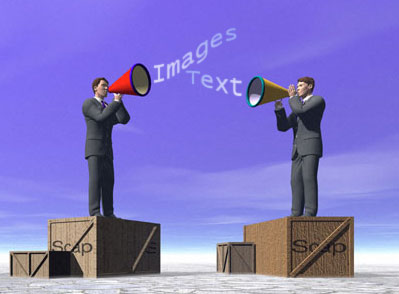
Today's culture is image-driven. Yesterday's world was word-based. While words may be the vehicles of truth, images forcefully drive home reality.

The human mind is made up of metaphors and images. The earliest recorded languages were pictographs. Do you dream in words or images? Why will you forget a name quicker than a face? Why will you remember where a quote was on a page but forget the quote itself? Because your visual memory is stronger than your textual/verbal memory. Check out these names: Michael Jordan, Saddam Hussein, Bill Clinton, Mike Tyson, Britney Spears, Dr. Mahathir – did an image of each of them pop into your brain? Think of the color of the pillows on your bed. How did you do that? Isn't it by replaying the picture of your bedroom, bed and so on, until you 'found' your pillow and '(re)-viewed' the color of its sheets? We 'do' a memory by re-presenting and recalling images.

Images come as close as human beings will get to a universal language. Propositions are often lost on today's learners, but metaphor they will hear; images they will see and understand. Image dictionaries[1] are replacing word dictionaries and image banks are becoming as valuable as money banks. Cyber-space itself is becoming less word-based and more image-based through the spread of avatars (one's self-created image online, your personal graphic identity in the cyber-world).

The greatest image in the world, the image to which we draw people into a relationship, is the image of God in Jesus the Christ.

If you want people to think differently, don't tell them how to think - give them a mental tool i.e. a metaphor or image. Metaphors lodge truth in the imagination. To sculpt a metaphor is to create and transform the world. The greatest communicators in history have used the wizardry of metaphor magic.

("The mind never thinks without a picture" Aristotle)

Jesus use parables, an image-based form of narrative. Dante created physical pictures of hell, purgatory and heaven that churches still hold on to today. Mosaic Church's[2] Erwin McManus' success in building a multicultural, multi-generational mission congregation is in part to his masterful employment of vivid images, not merely words, to embody his church's mission and values, e.g. seeing churches as "spiritual bomb shelters", "you can't wash the feet of a dirty world if you refuse to touch it." Albert Einstein liked to talk about the gift of 'fantasy' as being essential to his work. His insights came from visual images he conjured up intuitively, then translated into the language of mathematics e.g. the theory of special relativity was triggered by his musings on what it would be like to ride through space on a beam of light[3]. After watching The Passion of the Christ (the 2004 Mel Gibson-directed blockbuster on the final hours of Jesus), a Texan man confessed to the police of killing his girlfriend[4].

Visual language is no longer an option. We are a print-saturated, word-based church in the midst of visual technologies that are creating a whole new visual culture. Metaphors are the medium through which biblical spirituality will be fashioned for this new world.


("Parable is the root of the human mind – of thinking, knowing, acting, creating, and even of speaking." Mark Turner, Neural and Cognitive Scientist)

In defining realities, metaphors create realities and the most fundamental tools of thought. That's why the power of liturgy is so intense: Liturgy realigns our metaphors to conform to Christ, which transforms our lives. Julius Caesar and Joseph Stalin filled the landscape of their nations with images of themselves – images captured and subdued the imagination of the conquered. As the single-swoosh Nike will testify: The ultimate in power is not to have the first position or the last word but to have the ability to order and ordain metaphors. Images are a language of power.

Jesus exerted leadership not only through words but also via 'performances' or 'performance-metaphors'. He rode on a donkey, cleansed the temple, fed the thousands, raised the dead, turned water into wine, carried a cross, etc.

The Old Testament prophets spoke God's message using a wide range of dazzling and intense imagery (from almond rods to boiling cauldrons to bricks to furnaces and much more[5]) in addition to performing symbolic actions (e.g. Hosea and his unfaithful wife, Isaiah's public nakedness, etc.) If the Church is to present Christ to today's world, we must learn to communicate like Jesus: through metaphor, parable, icon, image.

("A religious symbol does not rest on any opinion." Ludwig Wittgenstein)


Interactives:

1. Take a moment and count the number of images and metaphors ascribed to God in the Bible (e.g. rock, shield, etc.). How many can you remember? Which is your favorite? Why? Finally, how about thinking of some new ones? (e.g. He is my Anti-Virus Protection?)
2. See, reflect and discuss with a close friend LIFE Magazine's 100 Photos That Changed the World at http://digitaljournalist.org/issue0309/lm_index.html
3. Reformer Ulrich Zwingli argued that money spent on images decorating Catholic churches should be spent on poor relief. For what were the poor if not the true images of God? So the Protestants stripped churches of artwork and divested books of 'illuminations' or pictures. Did Zwingli do the right thing?
4. Neurologist Antonio Damasio said that consciousness begins, "…when brains acquire the simple power of telling a story without words…" Consider staging a drama or a mime telling the story of Easter or Christmas, without narration, using only music and pictures[6].
5. A senior Coca-Cola exec once declared that the company could survive the loss of all its assets, provided it kept possession of the Coca-Cola logo. With the logo, it would be possible to walk into a bank and receive funding to replace the entire global infrastructure of the company. Do you believe him? Is a logo that important?
6. Look at the first historical Christian icon: . Look at Nike's swoosh: If someone suggested that our Christian icons have been 'robbed' by icon-driven marketing like Nike's, would (s)he be right?[7]
7. Theologian Robert Banks called films the "parables of the 21st-Century" – assuming he's right, how can the church take advantage of the movie phenomena? How can the Body of Christ turn Hollywood to its advantage?[8]
[1] See http://www.pdictionary.com/, http://www.infovisual.info/, etc.

[2] Visit Mosaic's website at http://www.mosaic.org/

[3] See TIME Magazine's article Was Einstein's Brain Built For Brilliance? at http://www.time.com/time/magazine/article/0,9171,1101990628-27180,00.html

[4] Read the BBC news story at http://news.bbc.co.uk/1/hi/entertainment/film/3570555.stm

[5] For a good listing of the imagery used, visit http://www.learnthebible.org/Prophets.htm

[6] One of the most moving videos of the Christian story circulating on the Web last year was the wordless but very powerful Lifehouse Everything skit. View it at http://www.youtube.com/watch?v=cyheJ480LYA

[7] Read Swoosh! The Perfect Icon for an Imperfect PostLiterate World at http://www.utne.com/1998-09-01/swoosh.aspx?page=1, which includes this insightful comment:
"(To) Christians the textless symbol (signified) silent rebellion against the ruling authorities. Within three centuries, the faith signified by the fish had transformed Rome into a Christian empire. Today, in an electronically accelerated culture, a symbol can change the face of society in about one-sixteenth that time."
[8] One attempt can be seen at http://www.reeldialogue.com/. This site is based on the founders' belief that, as "church" is becoming increasingly irrelevant in society, it is of paramount importance to use popular culture to speak to the lives of younger people and to teach older people how to begin that dialogue.
=================================================================================================================================================================
Alwyn Lau is a Researcher and Teacher at KDU College. Being an astute theological thinker, he is interested in theological methods, emerging theologies, as well as the relevance of the Christian faith to the emerging generation. Alwyn is also concerned about issues pertaining to education. He is presently studying for a Master of Business Administration degree after having his first degree in BScHons Economics (University of London, UK);. He blogs on http://www.alwynlau.blogdrive.com/.

Friday, October 17, 2008

Church/Future Reloaded (Pt. 2)


Church/Future Reloaded (Pt. 2):
From Linear to Loopy

Alwyn Lau


In 1968, Doug Engelbart introduced something called a "mouse" before a group of mathematicians and hippies gathered in San Francisco. The computer mouse became more than just a pointing device; it changed the channels of consciousness and sold the illusion of information space i.e. the mouse brought information closer to hand. The ability to manipulate meant a hunger for more information and richer connections. Manipulation / Getting our hands dirty / Creativity = Openness i.e. Loopy.


How does innovation come about? By 'brain-storming', by turning things 'upside down', by creating new starting-points, by switching the environment, by exploration from anywhere to anywhere i.e. by engaging in loopy mental processes.
What are the best stories? Those with twists and turns and which conclude by making you look back and rethink the story's elements i.e. those which moved you into loopy recall.
Why was M. Night Shyamalan's first movie, Sixth Sense, so popular? Because the movie was a huge loop which tied the beginning and end together perfectly.


The three great inventions in the history of learning: 1. the Greek alphabet (800B.C.), 2. the printing press (15th century) and 3. the Internet (a couple of years ago). Today's 21st century learners are voracious learners cum players. (But) They value ideas for less their content or 'truthfulness' and more for their vortex of energy, vitality, joy and their ability to tickle the soul. Making the grade means more than making good grades. Rhythm is everything. They learn not by sitting still and listening, but by interacting and doing, hence game learning, team learning, e-learning i.e. by playing.


(This entire bulletin series will be playful, loopy, paradoxical and ambiguous: Does it bother you?)


The Japanese government controlled the export of Sony's PS2 game machine because it called it a "general-purpose product related to conventional weapons[i][1]". They had the jitters because in 1998, a North Korean submarine was captured by the South Koreans. The submarine's radar and global-positioning equipment were built from joysticks, game pads and play gadgets made by Japanese consumer-electronic firms.


Today's learners will be accessing and processing information very differently from the previous generation. The invention of writing led to the dominance of the left side of the brain and a general eclipse of right-brain values. Consider: In Malaysia, why is the Science stream reserved for the 'bright' students and the Arts stream for all the rest? In other words, why is calculus considered a more advanced form of high-school study than, say, drawing? Is it any surprise that the modern education system was modeled after linear, factory-produced manufacturing processes? [Insert child, go through stages 1 to 12, out comes a social product…]


Linear Thinking
Loopy Thinking
Concept
Start from the Beginning
Predictable
Either/Or
Deductive / Inductive Logic
Certainty
Machine-like
Proof
Conclusion
"It doesn't make sense"
Get the Point?
Paradox / Provocation
Begin Anywhere
Chaotic
Both/And
Fuzzy Logic
[ii][2]
Mystery
Organic
Imagination
Continuity
"Let's make some sense out of it"
See the Picture?


Look at nature. How many straight lines do you see? How many right angles? Isn't life brimming with zig-zags, oxbows, razorbacks and curves? Does God appear to think straight? Systematic theology must point towards systemic theology or parabolic theology. Many of the Bible's stories and principles are far from absolutely logical:

· Want to be freed from Egyptian slavery? Sprinkle some lamb's blood on your door (Exodus 12:22-23)
· Want to conquer Jericho? Walk around the enemy fortress a few times and make lots of noise (Joshua 6:3-5)
Want to be the greatest? Be the least (Matthew 23:11)
Want to overcome your enemy? Let him slap your other cheek (Matthew 5:38-39)
Want to live? Die (Luke 9:24)
(And the list goes on)


Linear-fashioned theology must make room for an organic holistic banquet of narratives. Put linear and loop together and you get a helix (is someone thinking DNA?[iii][3])


Spiritual growth reflects organic growth more than mechanized processes. Like a tree, we grow from year to year, but we also experience cyclical seasons: progress, set-back, breakthrough, pruning, sorrow, rejoicing – year after year.


What would a loopy, spiraling, helical discipleship process look like?


***"Our traditional thinking is concerned with What IS. It isn't good at designing What CAN BE." Edward de Bono, Inventor of Lateral Thinking


Interactives:

1. List the ways in which Jesus taught his disciples (e.g. parables, symbol, sermons, etc.) – which are linear, which are loopy? (use the chart above) Now consider how YOU communicate (in office, with family, etc.) – what is your ratio of linearity/loopy-ness in thinking? Share this exercise with someone and discuss.

2. Think of something you wanted to know about God or theology (e.g. "How must the church deal with sin today?" or "Does God want Christians to be involved in politics?"). Now assume there are 4 people in your team-learning group – how would you go about assigning the research? What questions would you get each member to focus on? What sources – ancient and modern – would you get them to draw upon?

3. Turn to Psalms 23 and draw (or voice out) your impressions and feelings as you read it. Try to write your own psalm by mapping those images and feelings into new words.

4. Randomly generate a name from your mobile phone or computer – and pray for the person. Open the newspaper or news website, randomly pick an issue/event and pray for the victims or problems.

5. What are the benefits of attending a course entitled How To Improve Your Memory? Compare these with the benefits of learning How To Know Where To Find Things. Which course is more important for today?

6. A huge majority of Malaysian students learn by memorization. What if textbooks were to be banned from the school campus during exam days? What would be the consequences on the Malaysian education system?

7. "For Christians and the church to grow, the Bible should be outlawed." – how might this (provocative) statement make godly sense? (Hint: Think about underground Christians).

[i][1] http://findarticles.com/p/articles/mi_m0WVI/is_2000_April_25/ai_61866396

[ii][2] See http://www.wolfram.com/products/applications/fuzzylogic/examples/ for how fuzzy logic is used in classifying houses, representing age, choosing a job, image processing and so on.

[iii][3] A helix – the perfect combination of linear and loopy – is the model of DNA, the nucleic acids that contain and shape the human body's 30,000-40,000 genes and reside in the body's 70-100 trillion cells.

Alwyn Lau is a Researcher and Teacher at KDU College. Being an astute theological thinker, he is interested in theological methods, emerging theologies, as well as the relevance of the Christian faith to the emerging generation. Alwyn is also concerned about issues pertaining to education. He is presently studying for a Master of Business Administration degree after having his first degree in BScHons Economics (University of London, UK);. He blogs on http://www.alwynlau.blogdrive.com/.

Church/Future Reloaded (Pt. 1)


Church/Future Reloaded (Pt. 1):
From Here to Where?

Alwyn Lau


A United States general once said, "If you don't like change, you'll like irrelevance even less." We in the church, far from reverting to our traditional immutability (of thinking, of identity) must boldly face the task of reexamining our role, our methods and our priorities, in the light of a world changing at the speed of thought.


This series invites you – the reader, the community – to narrative loopy voyage into a future which is already the present.


Did You Know?[i][1]
· Sometimes size does matter. If you're one in a million in China, there are 1,300 people just like you. (In India, there are 1,100 people just like you)
· The 25% of the population in China with the highest IQ's is greater than the total population of North America. And more than 10 times the population of Malaysia. In India, it's the top 28%.
· Translation : They have more honors students than we in Malaysia have adults.


Did you know?
· There are over 110 million registered users of MySpace[ii][2] and if MySpace were a country, it would be the 11th-largest in the world (between Japan and Mexico)
· There are over 2.7 billion searches performed on Google each month. To whom were these questions addressed B.G.? (Before Google)
· The number of text messages sent and received every day exceeds the population of the planet.
· There are about 540,000 words in the English language, about 5 times as many as during Shakespeare's time.
· More than 3,000 new books are published - daily.
· It's estimated that a week's worth of a daily newspaper from a developed country contains more information than a person was likely to come across in a lifetime in the 18th century.
· It's estimated that 40 exabytes (that's 4.0 x 10¹⁹) of unique new information will be generated worldwide this year. That's more than in the previous 5,000 years. The amount of new technical information is doubling every 2 years. It's predicted to double every 72 hours by 2010.
· What does the church value most? How is information linked to truth and perspective?


Did you know?
· Third generation fiber optics has recently been separately tested by NEC and Alcatel that pushes 10 trillion bits per second down one strand of fiber[iii][3]. That's 1,900 CDs or 150 million simultaneous phone calls every second. It's currently tripling about every 6 months and is expected to do so for at least the next 20 years. The fiber is already there, they're just improving the switches on the ends. Which means the marginal cost of these improvements is effectively $0.
· 47 million laptops were shipped worldwide last year. The $100 laptop project is expecting to ship between 50 and 100 million laptops a year to children in underdeveloped countries[iv][4].
· Predictions are that by 2013 a supercomputer will be built that exceeds the computation capability of the Human Brain.. By 2023, a $1,000 computer will exceed the computation capability of the Human Brain . . .
· Predictions are that by 2049 a $1,000 computer will exceed the computational capabilities of the human race.


Interactives:
1. How do you feel after reading the above? Share your feelings with someone.
2. What part does/should the church play in this exabyte era? How is the church absorbing and constructing new information? Or are we generally passive players?
3. Futurist Alvin Toffler wrote that, "The illiterate of the 21st century will not be those who cannot read or write, but those who cannot learn, unlearn and relearn." Do you think he's right? How are you as a Christian – and how are we as a church – learning, unlearning and re-learning?
[i][1] The following is adapted from http://shifthappens.wikispaces.com/. Visit the link for updates on the facts and figures.
[ii][2] http://www.myspace.com/
[iii][3] http://www.abanet.org/genpractice/ereport/2007/may/technotes.html
[iv][4] http://news.bbc.co.uk/2/hi/technology/6224183.stm


Alwyn Lau is a Researcher and Teacher at KDU College. Being an astute theological thinker, he is interested in theological methods, emerging theologies, as well as the relevance of the Christian faith to the emerging generation. Alwyn is also concerned about issues pertaining to education. He is presently studying for a Master of Business Administration degree after having his first degree in BScHons Economics (University of London, UK);. He blogs on http://www.alwynlau.blogdrive.com/.

Values Within Us


VALUES WITHIN US


James Daniel


- Why do we do all the ethical things in our Workplace?
- Why is it that we do not steal from our companies?
- Why is it that we do not give bribes or even accept bribes?
- Why do we work hard and go the extra mile in our workplace?


How do we answer these questions? Many of us will agree that stealing, giving bribes etc are wrong but we may give different reasons as to why we believe these are wrong.


There is a famous American psychologist by the name of Lawrence Kohlberg who did a study on developing moral judgment. His studies were done mainly on the reason behind a moral action. He was interested in the structure in a moral judgment and not the content of the moral judgment. The content is "it is wrong to steal" where else the structure is "why it is wrong to steal". He found out that there are 6 stages of moral development in a person.


In the first stage, people do a certain moral thing because of Fear. If you ask people in this stage why they don't give bribes, they will say because they are afraid that they will be punished if they are caught. Everything good they do is not because they believe in the good itself, but rather because they are afraid of the consequences of doing bad. In a country like Malaysia where we do not see the government taking strong action against corruption, people become less fearful. As such, when there is no fear, the sense of doing right disappears.


In the second stage, people have good moral values because of the Reward they expect from their good deeds. I have known Christians who gives tithes and offerings just because they are expecting God to bless them back financially 100x more. This then becomes the main reason. Similarly, we can have workers in our workplace who works hard just to impress the bosses. They will make sure that their bosses see how hardworking they are and how committed they are just so that they can be promoted and probably get higher salary in their company.


In the third stage, a person will observe certain moral behaviors so that that person will be Accepted by some respected authority or group, be it a church or organization that the person is involved in. Just imagine if you attend a Christian group and if you tell them that you practice bribery in your company to secure contracts. I don't think you will be accepted in the long run. As such, you may decide not to give bribes anymore due to the peer pressure from such group. The problem is, when you move on to another group that believes it is OK to give bribes, then you change according to the belief of that new group. As such, this people's value changes depending on which group they are in.


In the fourth stage, a person's moral judgment is based on the Law of the society or some form of structure that is holding the society together. It is not based on fear, but rather on the belief that they need to respect and obey the law. This in itself is good because it keeps society in order. However, when this social order is taken away, the people's moral values collapses. In many countries where racial riots happen, neighbors who have been living peacefully for a long time suddenly starts to kill each other. Ever wondered why this happens?


In the last 2 stages, a person having good moral value does so in order to protect the rights and welfare of other people, rather than himself. Concern is given even for the minority. A person in this stage will say that it is wrong to steal "because it will violate someone's right of ownership and it is unjust to advance our own benefit at the expense of others". They do not steal not because of fear, not because they want to be rewarded, not because they feel it is the "right thing a Christian should do" or not even because of the law. Their conviction of not stealing is not based on their surrounding or the people they mix it. Rather, this highest moral value has been internalized in that person.


In Matthew 5 (Sermon on the Mount), we see Jesus telling the crowd 6 times "You have heard it said……. But I tell you……" In verse 21 Jesus said "You have heard it said that you shall not kill" and in verse 22 Jesus said "But I tell you, even if you get angry with your brother without a cause, you will be in danger of judgment"


In verse 27 and 28 Jesus said "you have heard it said , thou shall not commit adultery but I tell you that even if you look at a women lustfully, you have committed adultery with her in your heart"


He again used this same style of dialogue another 4 times in verses 31/32, 33/34, 38/39 and 43/44.


What was Jesus trying to teach over here? What the people were taught was correct, don't murder, don't commit adultery etc. But the people were obeying the law just as it was. No one knows the real reason why these people are obeying the law. They might be following the law just because they had to. Jesus comes and he does a wonder. He brings this same law to greater heights and he gives them new meanings and new dimensions. He wants them to have the law internalized within them. The people do not commit adultery because the law forbids them, but since there are no laws that forbid them from looking lustfully at women, they find nothing wrong with it. If we look deeper into this, we can ask the question "why is it wrong to commit adultery" and when we find the answer, is it not the same as looking at a women lustfully?

Similarly, as Christians, we need to have the "laws" internalized within us. Issues like ethics, integrity, high moral standard should be rooted deep down in us. We need to have these not because of fear, or reward, or acceptance, or because of the law itself, but rather because we need to see things, people and reason in the way Jesus would see them. And we need to get this like what the Sunday school song say "deep deep down in our heart".


James Daniel is currently working with Schlumberger as a Directional Driller Manager, drilling oil wells for oil companies. Married to Esther Wong, both of them attend Mar Thoma Syrian church in KL. James is also the current President of GCF. He can be contacted at Jdaniel@kuala-lumpur.oilfield.slb.com.